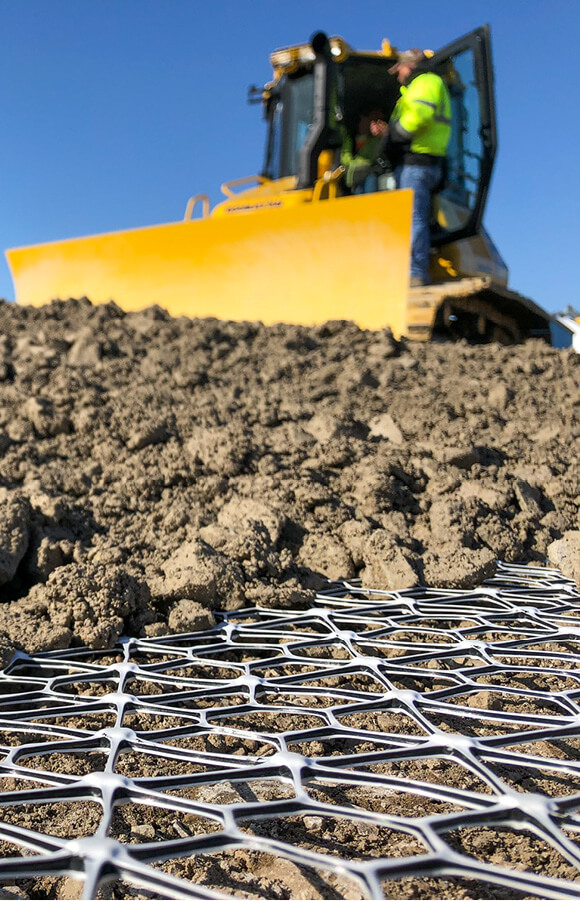
Stabilise and reinforce soil and aggregates with Tensar Geogrids
Solution Overview
Geogrids are manufactured from oriented high-density polyethylene (HDPE) or polypropylene (PP). A geogrid consists of a 2-dimensional arrangement of integrally connected tensile elements or ribs that form a grid or net-like structure, usually supplied in roll form. Manufactured from polymers, geogrids are classed as geosynthetic products; this is a broad product classification that includes geotextiles and geomembranes alongside other minor categories.
The junctions between ribs are integrally formed, giving them high strength and structural stability. Geogrids are used to solve civil and geotechnical engineering problems in or on the ground. They primarily provide a soil stabilisation or reinforcement function, to add to or enhance the properties of soil or aggregate materials, or to increase load-bearing capacity.
Geogrids were invented by our company founder, Dr Frank Brian Mercer, who patented his design in 1978. Since then, Tensar has been at the forefront of product innovation globally and manufactures the most advanced solution on the market – Tensar® InterAx® – which has made us the go-to solution for local authorities in the UK and around the world.
Need a Tensar design for your project?
Tensar’s design team can produce a free-of-charge “Application Suggestion” to illustrate what Tensar can achieve and how much value can be added to your project.
Tensar Geogrid Products
Loading...
There are no results that match your search. Please try another search or Contact Us with further questions.
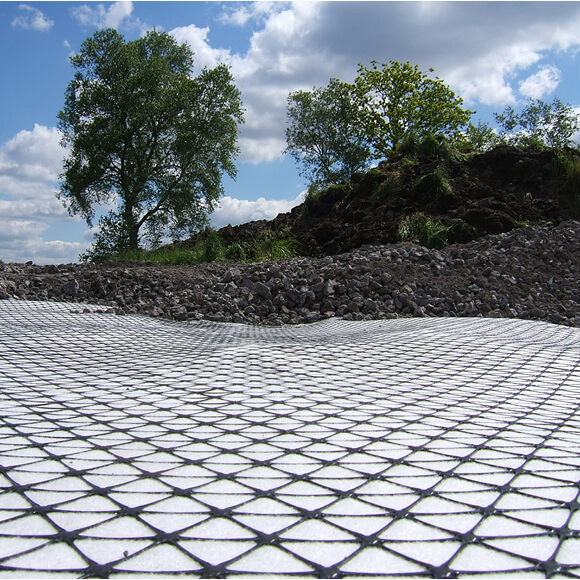
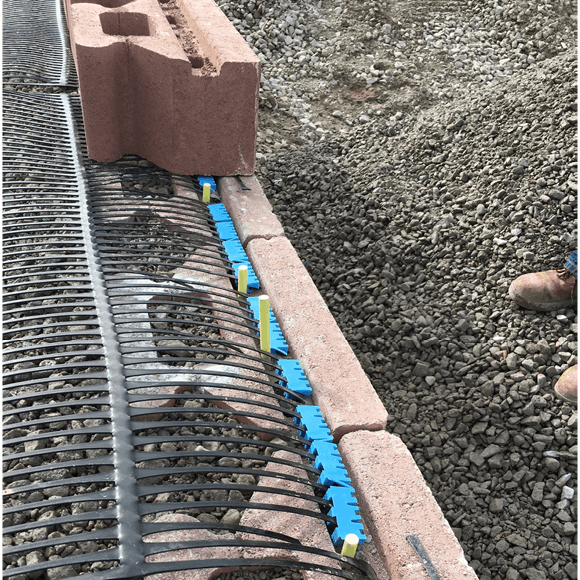
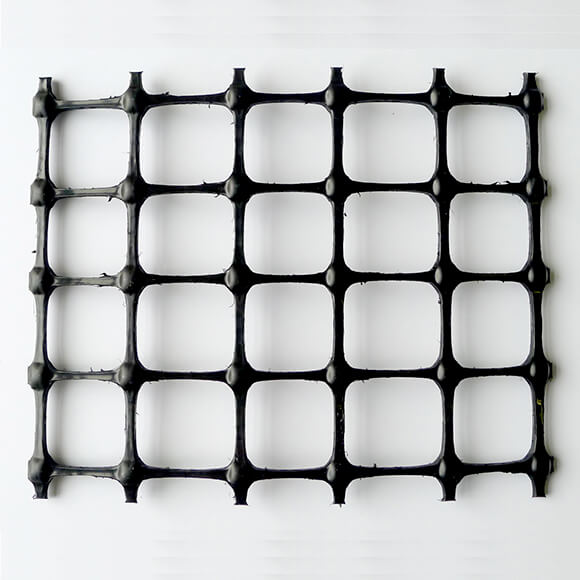
What is geogrid?
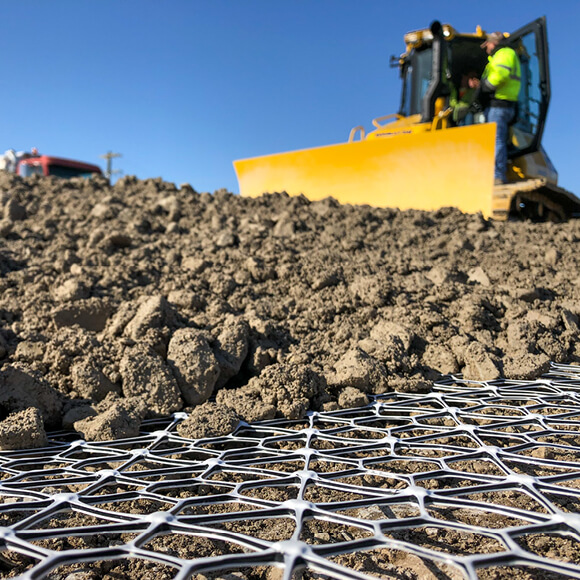
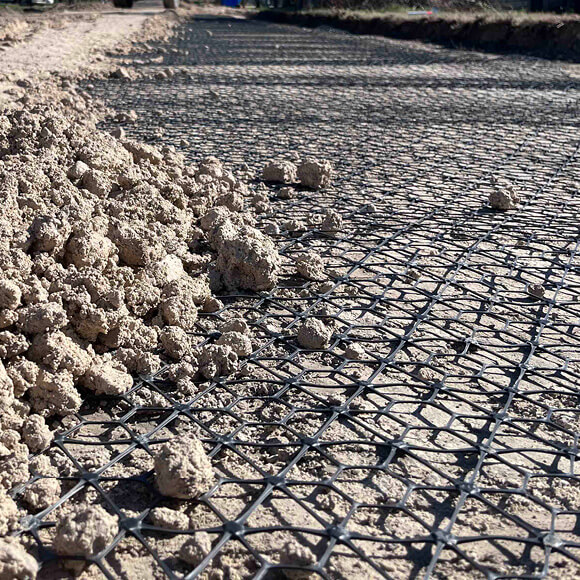
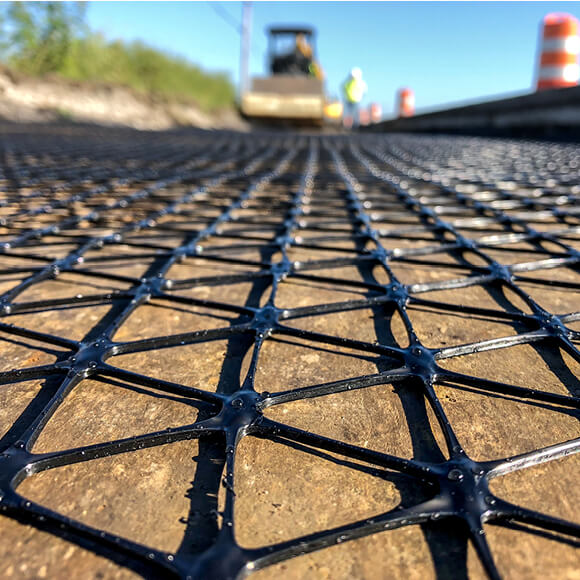
Geogrid is a type of geosynthetic material that provides a stabilisation and reinforcement function to aggregates and soils. The design comprises a two-dimensional pattern of ribs to form a series of apertures or open spaces, which enables geogrid reinforcement to stabilise and reinforce earth materials. This geogrid mesh effectively interlocks with the surrounding materials, enhancing the overall performance.
Read our comprehensive guide What is Geogrid & How Does it Work? to explore all about geogrid, including definition, functions, benefits, and applications.
The applications - what are geogrids used for?
Geogrids primarily provide a stabilisation or reinforcement function to enhance the performance of soils. They also provide separation between soil and aggregate layers and are used widely in civil engineering applications.
Geogrids can be used for the following applications:
Building stable working platforms over soft ground conditions
Enhancing the service life of roads, pavements and trafficked areas
Improving the long-term performance of paved and unpaved roadways by minimising aggregate movement
How do geogrids work?
Geogrids are a type of geosynthetic material that provides a stabilisation and reinforcement function to aggregates and soils. They make use of a two-dimensional pattern of ribs to form a series of apertures or open spaces, which enables geogrid reinforcement to stabilise and reinforce earth materials. This geogrid mesh effectively interlocks with the surrounding materials, enhancing the overall performance.
Geogrids work efficiently because the apertures between ribs allow the aggregate to strike through and interlock with the geogrid reinforcement. Provided the geogrid is stiff enough, the rib profile deep enough, and the junctions strong enough, earth materials are confined within the apertures to prevent the movement of aggregate. This forms a new geogrid/aggregate composite material with improved strength and resistance to deformation.
Testing and experience have shown that Tensar geogrids support the function of separation when properly graded aggregate fill is used. Our geogrids maintain drainage and are not prone to “blinding out” or clogging, which may occur with a geotextile used as a separation layer.
How do geogrid solutions reinforce soils?
For soil reinforcement geogrid applications, load must be transferred between the soil and the geogrid. The transverse ribs of uniaxial geogrids provide an efficient mechanism for load transfer by abutment rather than friction alone. The high tensile load in the geogrid is carried by the longitudinal ribs. They must be capable of sustaining such high loading for the full life of the structure (often up to 120 years), requiring durability and long term strength and stiffness.
Tensar geogrids are routinely excavated through and punched through in order to place underground utilities. The innovative design of geogrids allows them to withstand the stresses associated with trenching and backfilling. This ensures soil reinforcement remains effective after installation.
Who invented geogrids?
Geogrids were invented by Dr Frank Brian Mercer and patented in 1978. Prior to its acquisition, Mercer founded the company Netlon which went on to become Tensar. Continuing the tradition of innovating geosynthetics, Tensar still stands today as the world leader in geogrids, investing in the research and development of new products such as Tensar® InterAx®.
To learn more, see our booklet on Dr Frank Brian Mercer and the invention of polymeric geogrids.
Comparing Tensar Geogrids with alternative soil reinforcement solutions
The efficiency of the interlock and confinement provided by a geogrid is dependent upon its physical characteristics (in-plane stiffness, junction efficiency, rib profile) and compatibility with the aggregate (particle size and type). Different geogrids with the same short-term QC strength can have widely different characteristics dependent on the method of manufacture, the joint type, rib profile and polymer used.
For soil reinforcement applications, the geogrid mesh must have proven long-term strength and stiffness characteristics as well as high durability. Geogrids vary in their long-term characteristics, dependent upon the manufacturing methods and the polymer used. Tensar uniaxial geogrids are certified for a 120-year design life in a wide range of soil pH and chemically aggressive environments.
See below how Tensar’s geogrid solutions directly compare to other geogrids and ground reinforcement products.
.png "snippet-biax-250-250-(1).png")
Generic Biaxial Geogrids
- Products suited to bi-directional reinforcement
- Lower confinement efficiency due to effect of rib profile or lower junction strength provides reduced performance
- Design parameters typically based on small scale testing, or geogrid properties
- Typically not proven for use in road base, primarily utilised over weak ground
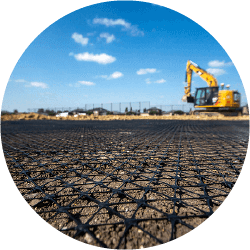.png "snippet-triax-250-250-(1).png")
Tensar® Geogrid
- Products optimised for mechanical stabilisation of aggregates
- Highly efficient aggregate confinement increases bearing capacity and limits surface deformations
- Design parameters developed from full-scale accelerated trafficking tests of mechanically stabilised layers
- Proven suitability for base stabilisation in permanent roads as well as road foundations over weak ground
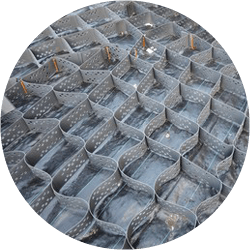.png "snippet-geocell-250-250-(1).png")
Geocell
- Aggregate or sand fill confined by cell walls to increase bearing capacity. Difficult to achieve compaction within cells
- Complex installation requires more labour and time to open, secure and place first layer. Fill is difficult over weakest soils
- Typically limited to installation over soft soils
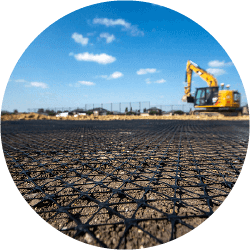.png "snippet-triax-250-250-(1).png")
Tensar® Geogrid
- Highly efficient aggregate confinement creates a mechanically stabilised layer with improved bearing capacity. Aggregate compaction is enhanced
- Installation costs are low. Quick and simple to roll out and commence fill. Over very weak soils access is made possible by ‘snowshoe effect’
- Proven suitability for base stabilisation in permanent roads to increase pavement life as well as for road foundations over weak ground
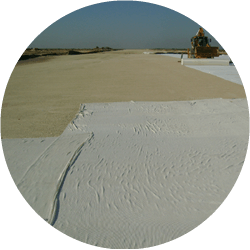
Geotextile Reinforcement
- Mobilisation of geotextile strength to reinforce aggregate is limited by friction
- Load support is developed by the tensioned membrane mechanism requiring higher surface deformation to mobilise the reinforcement effect
- Typically limited to installation over soft soils where surface rutting is permissible
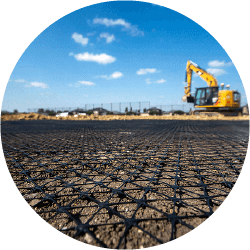.png "snippet-triax-250-250-(1).png")
Tensar® Geogrid
- Product design optimised for mechanical stabilisation of aggregates by interlock and confinement
- Highly efficient aggregate confinement by interlock increases bearing capacity and limits surface deformations
- Proven suitability for base stabilisation in permanent roads to increase pavement life as well as for road foundations over weak ground where surface rutting is to be limited
.png "snippet-chemical-stabilisation-250-250-(2).png")
Chemical Stabilisation
- Large equipment required for treatment. Difficult access over very weak soils. High mobilisation and set up costs limit use to larger area projects
- Limited to use with certain soil types and unsuitable for organic and certain clay soils
- Windblown dust can be an issue during installation. Drainage and hydrology of soil is affected.
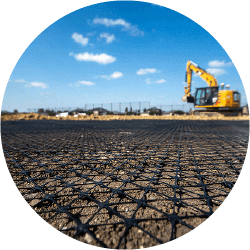.png "snippet-triax-250-250-(2).png")
Tensar® Geogrid
- Installation costs are low. Quick and simple to roll out and commence fill. Over very weak soils access is made possible by ‘snowshoe effect’. Suitable for projects of any size
- Mechanically stabilised layers can be used over all soil types including organic soils
- Mechanical stabilisation has minimum environmental impact during installation and when in-place. Suitable for end-of life excavation and disposal
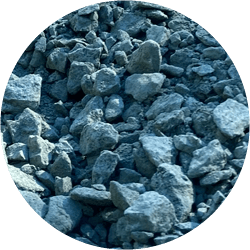.png "snippet-non-stabilised-250-250-(1).png")
Non-Stabilised
- Weak soils required to be excavated and disposed off-site, then backfill with suitable materials prior to placement of aggregate layers. Resulting in increased traffic movements, project costs and carbon emissions
- Thicker layers of aggregate required to achieve the same bearing capacity and surface rutting profile. Resulting in higher construction cost, increased time and greater carbon emissions
- Increasing pavement life would require an increase in thickness of the unbound layers, increasing overall costs, materials usage, and carbon emissions
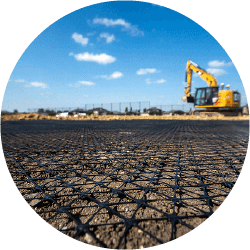.png "snippet-triax-250-250-(1).png")
Tensar® Geogrid
- Allows installation, placement, and compaction of aggregate layers over very weak and variable soils
- Mechanical stabilisation enables reductions in capping layer or subbase thickness over weak or variable soils
- Mechanical stabilisation of unbound layers in permanent roads increases pavement life or enables pavement layer thickness to be reduced for the same life

Design with confidence, from anywhere.
- Design & evaluate pavement and gravel sections
- Design & evaluate working platforms
- Easily compare alternative materials
- Determine initial and lifecycle cost savings, time savings, and sustainability metrics
- Create high-level summaries of the design alternatives for project stakeholders
- Share features that aid collaboration

Geogrid FAQs
What are the types of geogrids?
The main types of geogrids are the following: uniaxial geogrids, biaxial geogrids, TriAx® geogrids (TriAx®), Tensar H Series (HX) geogrids and Tensar InterAx® geogrids.
Read more: Geogrids Types & Their Physical Properties.
How can I choose the right length and type of geogrid for my project?
Selecting the appropriate geogrid requires a thorough analysis of project-specific factors. These include the type of load, the soil type (considering grain size and California Bearing Ratio - CBR), and the desired outcome (such as reinforcement or subgrade stabilisation). This analysis will help determine the necessary tensile strength, aperture size, and material type (e.g., polyester, glass fibre) for the geogrid. Read our article to know more about the physical properties of geogrids.
For expert guidance, always consult with geotechnical specialists or suppliers like Tensar for the most suitable geogrid selection.
How effective is geogrid?
Geogrids are highly effective at stabilising soils, reducing rutting in roads, and extending the life of pavements. Independent tests, including those on Tensar geogrids, have shown significant improvements in load distribution and reduction in aggregate thickness requirements.
Research by the U.S. Corps of Engineers (USCoE) and others using full-scale accelerated pavement testing (APT) has confirmed that using Tensar geogrids in flexible pavements reduced surface rutting by up to 44%.
Tensar InterAx Geogrid has also been shown to reduce the potential aggregate base by 70% and carbon emissions by 65%, while still improving pavement performance on stiff soils.
Read more: Research confirms geogrid improves pavement performance
Are geogrids a good option for improving the performance of roads and highways?
Yes, using geogrids for roads, particularly on weak or unstable soil, is an excellent option for improving the performance of roads and highways. They are used to reinforce the subgrade and granular layers (such as the sub-base), which increases the overall load-bearing capacity and stability of the pavement.
How does geogrid help with settlement?
Geogrids reduce and control settlement by distributing loads more evenly, improving ground stability, and minimising differential movement. This network improves the soil's tensile strength and stiffness. Read more about settlement in geotechnical engineering.
How do geogrids compare to geocells and geotextiles for soil stabilisation?
Geogrids, geocells, and geotextiles are all types of geosynthetic materials, but they have different structures and functions for soil stabilisation:
Geogrids provide reinforcement and interlock with soil and aggregates.
Geocells confine materials in three dimensions for load distribution.
Geotextiles mainly act as separators and filtration layers.
Read Tensar’s comparison article between geogrid and geotextile.
How much does Tensar geogrid cost?
The price of geogrids depends on volume and type. For more information, contact us so we can help you determine your price and the potential value we can add to your project.
What manufacturing processes are used to make geogrid?
Geogrid mesh can be punched into a polymer sheet; extruded through rotating die heads to create a net structure, or welded from strips of material, then woven or knitted from yarns.
Punched and drawn geogrids: Molten polymer is extruded into a sheet of defined thickness, and a pattern of holes is punched into the sheet. The punched sheet is then stretched in either a single direction to form a uniaxial geogrid or in two directions to form either biaxial or multi-axial geogrids.
Extruded geogrids: Molten polymer is extruded through rotating “die heads”, each with a series of “holes” which allow the creation of a “net” type structure. The geometry of the resulting net or geogrid is dependent on the die/extrusion configuration, with both uniaxial and biaxial products available.
Welded geogrids: Polymer strips are manufactured and are then bonded together to form a square or rectangular grid shape. The bonding would typically be carried out using heat.
Woven geogrids: Woven geogrids are fabricated by weaving polymer yarns together, or sometimes knitting polymer yarns together to form a net/grid-like structure. These woven products are often then coated with other polymer materials, such as polyvinyl alcohol (PVC), to form the final woven geogrid.
Geogrid/geotextile composites can be formed by bonding a geotextile separator fabric to the completed geogrid manufactured by the methods above.
It is important to note that whilst the inclusion of a geogrid in a roadway or platform would be expected to have a beneficial effect, these benefits will not be the same for each grade of geogrid product. In fact, research has shown that the manufacturing method can have an influence on the expected performance of the resulting road or platform.
How are geogrids installed?
Geogrids are installed by preparing the subgrade, then rolling out the material so that it follows the natural contours of the ground. The placement of the geogrid depends on the type that you are using. As such, we’ve created a range of installation guides to help:
What is the lifespan of a geogrid?
The lifespan of a geogrid ranges from 20 to 120 years, depending on material (polypropylene or polyester), environmental conditions (UV exposure, soil chemistry), and quality of installation.
Tensar uniaxial geogrids are certified for a 120-year design life in a wide range of soil pH and chemically aggressive environments.
What are the sustainability benefits of geogrids?
Geogrids offer several key sustainability benefits that make them an environmentally friendly choice for construction projects:
Lower carbon footprint: Fewer materials mean fewer trucks needed to transport them to the site. This directly translates to lower fuel consumption and reduced greenhouse gas emissions.
Extended lifespan: Geogrids increase the durability and lifespan of infrastructure, reducing the frequency of repairs and reconstruction. This minimises the consumption of resources and energy associated with repeated maintenance and rebuilding.
Use of recycled materials: Many geogrids are made from polymers that can be recycled, further contributing to a circular economy.
For more information, discover how Tensar geogrids contribute to environmental sustainability:
What role can plastics and geogrids play in sustainability?
The efficiency of the interlock and confinement provided by a geogrid depends on its physical characteristics (in-plane stiffness, junction efficiency, rib profile) and its compatibility with the aggregate (particle size and type). Different geogrids with the same short-term QC strength can have widely different characteristics dependent on the method of manufacture, the joint type, rib profile and polymer used.